Dental Bonding in Markham: The Affordable Cosmetic Fix Most Patients Overlook
There is a cosmetic dental treatment available in Markham that most patients have either never heard of or dismissed as inferior to veneers. It requires a single appointment, involves no permanent enamel removal, costs a fraction of porcelain alternatives, and can fix a chipped tooth, close a small gap, reshape an uneven edge, or cover a stubborn stain in an hour.
Dental bonding composite resin applied directly to the tooth and sculpted to your desired result is the most underutilised cosmetic tool in dentistry. Markham patients who have been living with a small cosmetic concern for years, convinced that treatment would be expensive, invasive, and time-consuming, are frequently surprised to learn the reality is none of those things.
This guide covers everything Markham patients need to know: what bonding can and cannot fix, what it genuinely costs in Ontario, how long it lasts, what causes it to stain and how to slow that process, and when bonding is the smart choice versus veneers or whitening.
What Is Dental Bonding?
Dental bonding also called composite bonding or tooth bonding is a cosmetic dental procedure in which a tooth-coloured composite resin is applied directly to the surface of a tooth, shaped and sculpted to the desired form, and hardened using a curing light. The result blends seamlessly with the surrounding natural tooth.
Unlike porcelain veneers, which are custom-fabricated in a dental laboratory and require a separate preparation appointment, bonding is done entirely chairside by Dr. Reza's hands, in a single visit, with no laboratory involved.
The procedure typically takes 30–60 minutes per tooth, is performed without anaesthetic in most cases (unless decay is present or the tooth is sensitive), and requires minimal to no removal of healthy enamel. The composite is matched precisely to the shade of your surrounding teeth using a colour guide before placement begins.
Is Dental Bonding Worth It?
For the right patient and the right clinical situation yes, dental bonding is absolutely worth it. The question is defining what "right" means.
Bonding is worth it when:
The concern is specific and localised. A single chipped front tooth, a small gap between two teeth, a discoloured spot that does not respond to whitening, or a slightly uneven incisal edge these are the situations where bonding delivers a dramatic result in one appointment at a fraction of the cost of alternatives.
You want the most conservative option. Bonding requires little or no enamel removal. Porcelain veneers typically require 0.5–0.7mm of permanent enamel reduction. For a patient who wants cosmetic improvement without permanently altering healthy tooth structure, bonding is the most conservative pathway.
Budget is a genuine consideration. Dental bonding in Ontario costs approximately 200–600 CAD per tooth compared to 800–2,500 for a porcelain veneer. On a single tooth, bonding costs roughly one-quarter to one-third of a veneer. For a cosmetic fix on one or two teeth, bonding is a genuinely excellent value.
The result needs to be reversible. Because bonding involves minimal or no enamel removal, it can be removed or replaced without permanently altering the underlying tooth. Veneers, which require enamel reduction, are not reversible in the same way.
Bonding is less worth it when:
The concern is widespread. If six to eight front teeth need cosmetic improvement, the time and cost of bonding each one individually begins to approach the cost of veneers which will last significantly longer and are more stain-resistant. For comprehensive smile makeovers involving many teeth, porcelain veneers often represent better long-term value.
Severe discolouration is involved. Composite resin has limits in masking very dark staining (for example, from tetracycline antibiotic use in childhood or significant intrinsic discolouration). Porcelain veneers provide better coverage in these cases.
Heavy bite forces are a factor. Composite resin is not as hard as porcelain or enamel. In patients with strong bite forces or bruxism, bonding on teeth that take significant occlusal load is more prone to chipping and wear.

What Can Dental Bonding Fix?
Dental bonding addresses a specific range of cosmetic concerns most of them the kind that Markham patients have been living with for years because they assumed treatment was more involved than it actually is:
Chipped or fractured teeth. The most common bonding application. A chipped front tooth from biting something hard, a childhood fall, or simply an old chip that has been bothering you can be repaired in a single appointment. The composite is built up to replace the lost tooth structure and polished to a natural finish.
Small gaps between teeth (diastema). A small space between the front teeth can be closed, reduced, or reshaped using bonding without orthodontics. Note that for larger gaps or cases where the spacing reflects a bite issue, Invisalign or orthodontics may be more appropriate your dentist will advise honestly.
Discolouration or staining that does not respond to whitening. Some staining is intrinsic occurring within the tooth structure rather than on the surface and does not respond to bleaching. A bonded layer over the tooth surface covers it effectively in a single appointment.
Uneven or misshapen teeth. A tooth that is shorter than its neighbours, pointed, or irregularly shaped can be built up and reshaped with composite to create a more uniform, proportionate appearance.
Minor length restoration on worn teeth. Patients with mild tooth wear from grinding or acid erosion can have the natural tooth length partially restored with bonding though night guard use is essential alongside this treatment to prevent the bonding from wearing as quickly as the natural enamel did.
Exposed root surfaces. Where gum recession has exposed the root surface of a tooth which is naturally darker and more sensitive than enamel-covered tooth bonding can cover the exposed area, reducing sensitivity and improving aesthetics.
How Long Does Dental Bonding Last?
Dental bonding typically lasts 3–7 years before refinishing or replacement is needed. With attentive care and favourable circumstances, some bonded teeth remain in good condition for up to 10 years.
The variables that most affect bonding longevity are:
Location of the bonded tooth. Front teeth used for biting (incisors and canines) receive different forces than back teeth. Bonding on front teeth used to cut and bite food is subject to the direct shear forces of every meal. This is a normal use case and bonding handles it well but it is more demanding than bonding on a tooth that primarily receives polishing-type contact.
Bruxism (grinding or clenching). Patients who grind their teeth at night place repeated high-load force on their teeth that wears composite resin faster than normal chewing. If you grind, a night guard is essential before bonding is placed otherwise the bonding will wear or fracture significantly faster than it would in a non-grinder.
Diet and habits. Biting fingernails, chewing pens, opening packaging with your teeth, chewing ice these habits place lateral forces on bonded teeth that the composite is not designed for and will chip it.
Oral hygiene and professional maintenance. Bonding is monitored at every routine recall appointment at Hwy7 Family Dentistry checking for any chipping, staining, or edge wear that benefits from early refinishing rather than waiting until full replacement is needed.
The Truth About Bonding and Staining
This is the most important practical information for Markham patients considering bonding and the area where patients are most commonly underprepared.
Composite resin stains more than porcelain. This is not a flaw it is a known property of the material, and understanding it allows patients to manage it effectively.
Here is why it happens: composite resin, unlike porcelain, is a porous material at the microscopic level. Over time particularly in the first few years after placement the surface of the resin absorbs pigments from strongly coloured foods and beverages. Coffee, tea, red wine, curry, soy sauce, berries, and tomato-based sauces are the most common staining agents.
How to slow staining:
Rinse with water immediately after consuming staining foods or beverages. You do not need to brush immediately a simple water rinse within a few minutes of consuming coffee or tea significantly reduces the pigment available to absorb into the resin surface.
Use a non-abrasive toothpaste. Highly abrasive whitening toothpastes scratch the surface of composite resin over time, increasing surface roughness and accelerating staining. Use a gentle, fluoride toothpaste on bonded teeth.
Avoid smoking. Tobacco stains composite resin significantly faster than it stains natural enamel and the staining is more difficult to remove. If you smoke, bonding will discolour more quickly.
Professional polishing at your recall appointments. Your dental hygienist uses instruments and pastes that remove surface staining from composite resin during your routine cleaning. Attending your regular recall appointments is the most effective maintenance strategy for bonded teeth.
Critical rule: whiten before you bond, never after. Teeth whitening bleaches natural tooth enamel it has no effect on composite resin. If you whiten your teeth after bonding is placed, your natural teeth will lighten while the bonding stays its original shade, creating a visible mismatch. Always complete any professional whitening first, allow the shade to stabilise (approximately two weeks), and then have bonding placed to match the new, lighter shade. For a complete guide to professional whitening options for Markham patients, see our teeth whitening Markham guide.
Dental Bonding vs Veneers vs Whitening: How to Choose
The three most common cosmetic tools in dentistry address overlapping concerns with different trade-offs. Here is how to choose:
Factor | Dental Bonding | Porcelain Veneers | Professional Whitening |
Cost per tooth (Ontario 2026) | 200–600 | 800–2,500 | 300–800 (full treatment) |
Appointments needed | 1 | 2–3 | 1 (in-office) |
Enamel removal | Minimal / none | Yes (permanent) | None |
Reversible? | Yes | No | Yes |
Stain resistance | Moderate | High | N/A (natural enamel) |
Lifespan | 3–7 years | 10–20 years | 1–3 years |
Fixes chips/gaps? | Yes | Yes | No |
Fixes intrinsic staining? | Yes (covers it) | Yes (covers it) | No |
Fixes surface staining? | Partially | Yes | Yes |
Best for | 1–3 specific concerns | Comprehensive multi-tooth transformation | Overall brightening of natural teeth |
Choose bonding when: You have a specific localised concern a chip, a gap, a stain, an uneven edge on one to three teeth, and you want the most conservative, most affordable, single-appointment solution.
Choose veneers when: You want a comprehensive transformation across multiple front teeth, you want maximum stain resistance and longevity, and you are ready for a multi-appointment process with a higher investment. See our complete dental veneers Markham guide for the full comparison.
Choose whitening when: Your concern is primarily overall tooth colour on otherwise healthy, intact teeth. Whitening is the most conservative and cost-effective option for colour improvement but it cannot fix chips, gaps, or structural concerns.
For a comprehensive smile improvement involving multiple treatments, see our smile makeovers in Markham guide which covers the correct sequencing of bonding, whitening, and veneers in a multi-treatment plan.
The Dental Bonding Procedure: What Happens at Hwy7 Family Dentistry
The bonding appointment at our Unionville, Markham practice is typically the dental appointment patients feel best prepared for because what happens is genuinely simple.
Step 1 Shade matching. Dr. Reza selects the composite resin shade using a colour guide held against your natural teeth in natural light. The goal is a perfect match so the bonding is indistinguishable from your surrounding enamel.
Step 2 Surface preparation. The tooth surface is lightly etched with a mild conditioning gel this creates microscopic surface roughness that allows the bonding agent to grip the tooth securely. No drilling, no anaesthetic required in most cases. If the bonding involves a decayed area or a very sensitive tooth, local anaesthetic may be used.
Step 3 Bonding agent. A liquid bonding resin is applied to the prepared surface and cured with the ultraviolet light it takes seconds.
Step 4 Resin application and sculpting. The composite resin is applied in layers, each cured separately, and sculpted by Dr. Reza into the precise shape required. This is the artistic phase of the procedure achieving a natural contour, correct contact with adjacent teeth, and a shape that complements your facial proportions.
Step 5 Bite check and finishing. Once the shape is correct and the resin is fully cured, the bite is checked carefully. Any areas of premature contact are adjusted. The surface is then polished progressively with finer instruments until the resin has the same smooth, natural sheen as the surrounding enamel.
The appointment is typically 30–60 minutes for a single tooth, slightly longer for multiple teeth. Most patients leave the practice having never experienced any discomfort.
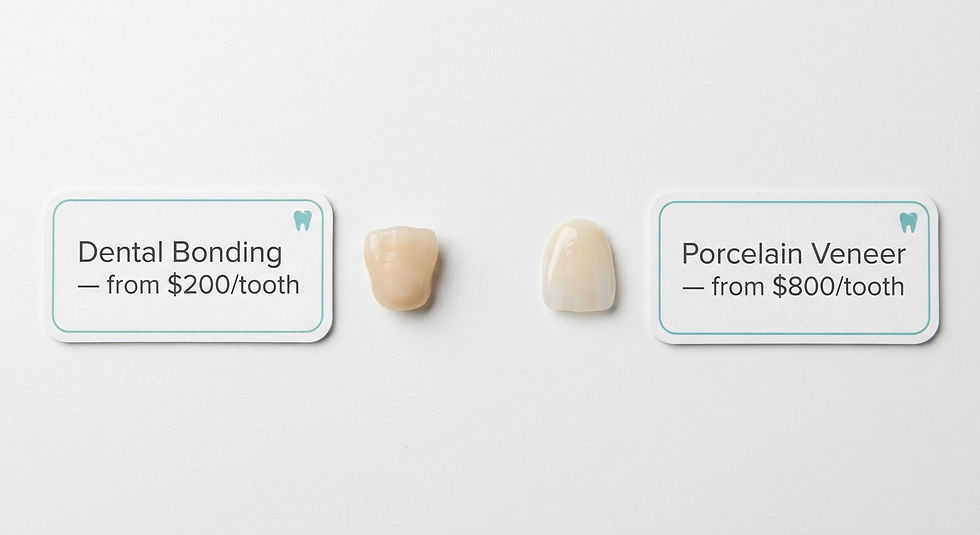
Dental Bonding Cost in Markham: What to Expect in 2026
Dental bonding in Ontario costs approximately 200–600 CAD per tooth making it the most affordable cosmetic dental procedure available in Markham.
Scope | Estimated Cost (Ontario 2026) |
Single tooth (minor chip or spot) | 200–400 |
Single tooth (full surface or complex shaping) | 400–600 |
Two to four teeth | 400–1,800 |
Six front teeth | 1,200–3,600 |
These figures reflect Ontario cosmetic clinic pricing for 2026. Individual costs depend on the extent of work per tooth, the number of teeth treated, and the complexity of the shaping required.
Important note: Cosmetic bonding is not regulated by the Ontario Dental Association's suggested fee guide it is not a schedule procedure in the same way restorative treatments are. This means prices vary more between practices for bonding than for fillings or crowns.
Insurance coverage: Purely cosmetic dental bonding placed to improve appearance rather than repair damage is generally not covered by standard Ontario dental insurance plans.
However, bonding placed to repair a fractured or chipped tooth, to cover exposed root surfaces, or to restore a tooth with decay may be partially covered as a restorative composite filling. If your concern has both a cosmetic and a structural component, it is worth having the treatment pre-determined with your insurer before proceeding.
CDCP coverage: The Canadian Dental Care Plan covers restorative composite bonding (fillings) for eligible patients but not purely elective cosmetic bonding. Hwy7 Family Dentistry is a registered CDCP provider and can help you understand what is and is not covered in your specific situation.
Frequently Asked Questions
Is dental bonding worth it?
For localised cosmetic concerns a single chip, a small gap, a stubborn stain, an uneven edge dental bonding is one of the best value cosmetic procedures available. Single appointment, no enamel removal, 200–600 per tooth in Ontario, and results that are genuinely natural-looking when placed by an experienced dentist. It is not the right choice for comprehensive multi-tooth transformation, where porcelain veneers offer better longevity and stain resistance for a more significant investment. For the right indication, bonding is excellent value.
How long does dental bonding last?
Dental bonding typically lasts 3–7 years before refinishing or replacement is needed. With careful maintenance avoiding biting hard objects, regular recall appointments, and rinsing after staining foods some bonded teeth remain in good condition for up to 10 years. Patients who grind their teeth should use a night guard, as grinding significantly shortens bonding lifespan.
Does dental bonding stain?
Yes composite resin stains more readily than porcelain or natural enamel. Coffee, tea, red wine, and tobacco are the main staining agents. The staining is manageable: rinsing after consuming staining foods, using non-abrasive toothpaste, and attending regular professional cleanings all slow the process. At recall appointments, surface staining is polished off as part of your routine hygiene appointment.
Can dental bonding be whitened?
No composite resin does not respond to whitening treatments. This is why the correct sequence for patients who want both whitening and bonding is always: whiten first, allow the shade to stabilise (approximately two weeks), then bond to match the new lighter shade. Never bond first and whiten after it creates an unmatchable colour mismatch.
Does dental bonding hurt?
In most cases, bonding is completely painless no anaesthetic required. The conditioning process and resin application involve no drilling and no discomfort for the vast majority of patients. If the bonded area involves decay or a particularly sensitive tooth, local anaesthetic may be applied.
Can dental bonding fix a gap between front teeth?
Yes for small to moderate gaps (diastemas), bonding is a conservative, affordable, single-appointment alternative to orthodontics. For larger gaps or cases where the spacing reflects a bite discrepancy, Invisalign or orthodontics may be more appropriate. Dr. Reza will advise you honestly at your consultation.
Book Your Dental Bonding Consultation in Markham
If there has been something small about your smile that has been bothering you for years a chip, a gap, a stain, an uneven edge a bonding consultation at Hwy7 Family Dentistry will take 15 minutes and give you a clear picture of whether bonding is the right solution, what it will look like, and what it will cost.
No pressure. No commitment. Just honest guidance and a clear answer.
Located at 4560 Highway 7 East, Unit 500, Unionville, Markham. Currently accepting new patients with Thursday evenings until 9 PM and Saturday appointments available.
📞 Call us at (905) 604-1995 🌐 Book your consultation at hwy7familydentistry.ca


Comments