Dental X-Rays in Markham: How Often, Types, Safety & What They Show
If you've ever sat in the dental chair and wondered "Do I really need these X-rays?" you're not alone. It's one of the most common questions patients ask at Hwy7 Family Dentistry right here in Markham.
The short answer: yes, for most patients, dental X-rays are a necessary part of your care. They let your dentist see what's happening between your teeth, below your gumline, and inside your jawbone things that are completely invisible during a visual exam.
But not all X-rays are the same. How often you need them, which type is right for you, and how much radiation you're actually exposed to are all important questions and the answers are more reassuring than you might think.
This guide covers everything Markham patients need to know about dental X-rays: the types, the frequency, the safety, and exactly what they're looking for.
Why Dental X-Rays Matter
Your dentist can examine the surfaces of your teeth and the health of your gums during a routine checkup. But up to 40% of tooth decay starts between teeth in spots where no probe or mirror can reach.
Dental X-rays change that. They give your dentist a complete picture of your oral health, including:
Cavities between teeth the kind that can go undetected for years without imaging
Bone loss an early warning sign of gum disease and the most reliable way to track it over time
Infections and abscesses especially under existing crowns or deep below the gumline
Impacted teeth including wisdom teeth that haven't erupted yet
Tumours and cysts rare, but only detectable on X-ray
Root canal problems checking whether the roots of your teeth are healthy
At Hwy7 Family Dentistry in Markham, X-rays are never taken routinely for the sake of it. Every image we take has a clinical reason and it's always guided by your specific health history and risk level.
How Often Should You Get Dental X-Rays?
The Canadian Dental Association (CDA) takes a risk-based approach to X-ray frequency meaning there's no single fixed schedule that applies to everyone. The right interval depends on your age, oral health history, and current risk level.
For Low-Risk Adults (no recent cavities, healthy gums, no active concerns):
Bitewing X-rays every 18–24 months
Full mouth series (panoramic or periapical set) every 3–5 years
For Moderate-to-High Risk Adults (history of cavities, gum disease, dry mouth, smoking):
Bitewing X-rays every 6–12 months
Full series as clinically indicated
For Children and Teens:
Annually, or as soon as back teeth are touching children are more cavity-prone and their mouths change rapidly. A panoramic X-ray is typically taken once in the pre-teen years to check permanent tooth development.
New Patients:
A full mouth series (or panoramic + bitewings) is recommended at your first visit to any Markham dental office, including Hwy7 Family Dentistry. This gives your dentist a baseline to compare against at future appointments.
As Sunnybrook Hospital's chief of dentistry puts it, the decision "always has to be patient-specific and risk-based." The CDA also recommends simply asking your dentist why a specific X-ray is being recommended and any good dentist will be happy to explain.

Types of Dental X-Rays
Not all dental X-rays are the same. Different types capture different areas and serve different purposes. Here's a plain-language breakdown of the four types you're most likely to encounter at a Markham dental office:
1. Bitewing X-Rays
The most common type. They show the upper and lower back teeth in one image, and are excellent for catching cavities between teeth and early bone loss. You bite gently on a small sensor tab while the image is taken quick and painless.
2. Periapical X-Rays
These show the full length of one or two specific teeth from the crown all the way to the root tip and the surrounding bone. Used when your dentist needs a detailed look at a specific tooth: before a root canal, to assess an abscess, or to investigate tooth pain.
3. Panoramic X-Rays (OPG)
A single wide-angle image of your entire mouth all teeth, both jaws, the sinuses, and your jaw joints. The machine rotates around your head (nothing goes in your mouth) and takes about 20 seconds. Used for new patient exams, wisdom tooth assessment, implant planning, and orthodontic evaluations.
4. Cone Beam CT (CBCT)
A 3D image of the teeth, bone, nerves, and sinuses the most detailed dental imaging available. Used for complex implant planning in Markham, surgical assessments, and evaluating impacted teeth. Not used for routine checkups.
At Hwy7 Family Dentistry in Markham, we use digital X-ray technology for all imaging. Digital sensors capture a clear image in seconds and allow your dentist to zoom in, adjust contrast, and share the image with you on-screen immediately.
Are Dental X-Rays Safe?
This is the question patients ask most often and the answer is genuinely reassuring.
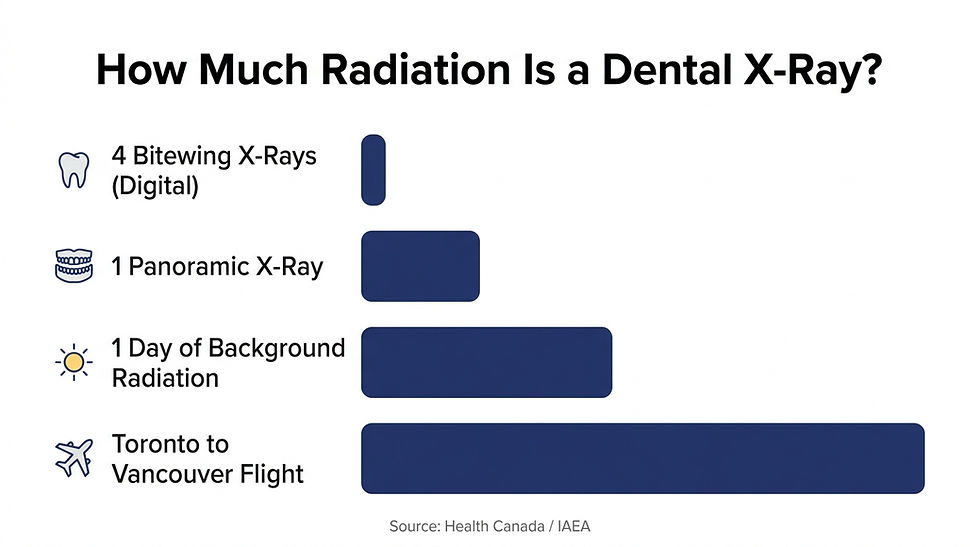
Dental X-rays involve an extremely small radiation dose. For context:
Source | Radiation Dose |
4 bitewing X-rays (digital) | ~0.005 mSv |
1 panoramic X-ray | ~0.01 mSv |
1 day of natural background radiation (living on Earth) | ~0.01 mSv |
A flight from Toronto to Vancouver | ~0.03 mSv |
Annual background radiation (Canadian average) | ~1.8 mSv |
Four bitewing X-rays expose you to roughly the same radiation you'd receive in half a day of everyday life.
Digital X-rays reduce exposure even further modern digital sensors require up to 80–90% less radiation than traditional film X-rays. This is the standard of care at Hwy7 Family Dentistry.
Additional safety measures at our Markham clinic:
Lead aprons used for every X-ray
Thyroid collars available on request
X-rays are only taken when clinically indicated never on a blanket fixed schedule
Pregnant patients:
Guidelines generally suggest postponing non-emergency X-rays during the first trimester, but the radiation dose from a dental X-ray is considered negligible. If you have a dental concern during pregnancy, speak with your dentist in many cases, a targeted X-ray is the safest way to avoid a larger problem.
Children:
Children receive X-rays more frequently because their mouths change rapidly and they're more cavity-prone. The dose remains very small with digital technology, and the risk of missing a cavity or developmental issue far outweighs the minimal exposure.
What Happens When You Skip Dental X-Rays?
Patients sometimes decline X-rays out of concern about radiation or cost. Here's what can go undetected when they're consistently skipped:
Cavities between teeth are the most common type of cavity in adults and completely invisible to the eye. By the time they cause pain, they've often grown large enough to need a crown or a root canal.
Bone loss from gum disease happens silently. X-rays are the only reliable way to measure bone levels and track whether they're stable or declining. Without this data, gum disease treatment becomes guesswork.
Infections under crowns can develop at the root level with no symptoms for months until significant pain sets in. X-rays catch these early.
Wisdom tooth problems an impacted wisdom tooth causing no pain can still damage neighbouring teeth, cause cysts, or create crowding. Panoramic X-rays catch this when management is far simpler.
The bottom line: regular X-rays, taken at the right interval for your risk level, are almost always less costly than treating the problems they catch late.
Dental X-Rays at Hwy7 Family Dentistry in Markham
Our approach to X-rays is the same as our approach to all care: individualized, evidence-based, and explained clearly before we proceed.
New patients receive a full baseline set so we have a complete picture of your starting point
Returning patients receive X-rays at intervals matched to your personal risk level not a one-size-fits-all schedule
We explain every image what we're looking for, what we found, and what it means for your care
We use digital X-ray technology faster, clearer, and up to 90% lower radiation than traditional film
Questions about your X-ray schedule or Ontario dental insurance coverage? Call us at (905) 604-1995 or book your appointment online.
Conclusion
Dental X-rays are one of the most important tools your dentist has not because they're used constantly, but because they reveal what a visual exam simply cannot.
For most healthy adults in Markham, bitewing X-rays every 18–24 months and a periodic full-mouth series are all that's needed. Children and patients with active dental concerns may need them more often. And with digital technology, the radiation involved is genuinely minimal roughly equivalent to spending half a day outdoors.
Hwy7 Family Dentistry is now accepting new patients in Markham.
📞 (905) 604-1995
Open Monday through Saturday, with extended Thursday hours until 9 PM for your convenience.
6. FAQ
Q1: How often should you get dental X-rays in Ontario?
For most healthy adults, bitewing X-rays every 18–24 months is the general guideline recommended by the Canadian Dental Association (CDA). However, frequency depends on your individual risk level patients with a history of cavities or active gum disease may need X-rays every 6–12 months. Children typically need them annually. Your Markham dentist will advise you based on your specific oral health history.
Q2: Are dental X-rays safe?
Yes. Dental X-rays involve a very small dose of radiation four bitewing X-rays expose you to roughly the same radiation as half a day of normal background radiation from the environment. Digital X-rays, which are standard at Hwy7 Family Dentistry in Markham, reduce exposure by up to 80–90% compared to traditional film. Lead aprons are used as an additional precaution.
Q3: What are the different types of dental X-rays?
The four main types are: bitewing X-rays (routine checkups, detecting cavities between teeth), periapical X-rays (full view of a specific tooth from crown to root), panoramic X-rays (wide-angle view of the entire mouth and jaws), and cone beam CT (CBCT) scans (3D imaging used for implant planning and complex cases).
Q4: Do I need dental X-rays if I have no pain or symptoms?
Yes many serious dental problems, including cavities between teeth, early bone loss from gum disease, and infections under crowns, cause no pain until they're advanced. Dental X-rays are the only reliable way to detect these conditions early, when treatment is simpler and less expensive.
Q5: Are dental X-rays covered by insurance in Ontario?
Most dental insurance plans in Ontario cover routine bitewing X-rays at regular intervals often once every 12–24 months depending on your plan. Panoramic X-rays are typically covered periodically as well. Ask the Hwy7 Family Dentistry team to help verify your coverage before your appointment.


Comments