Root Canal Treatment in Markham: The Complete 2026 Patient Guide
Updated: Oct 6
Root canal treatment has the worst reputation in dentistry and almost none of it is deserved in 2026.
The image most patients carry is outdated by decades: a long, painful procedure that belongs in a horror story. The reality for Markham patients receiving a root canal at a modern, experienced dental practice is something genuinely different: an appointment that feels similar to having a filling placed, after which the toothache that drove you to the dentist is gone.
This is the complete guide for Markham patients who have been told they need a root canal or who suspect they might. It covers what actually happens step-by-step on treatment day, what the procedure costs in Ontario in 2026, whether extraction is a better option, what CDCP covers, and what comes after treatment is complete.
If you are still in the decision stage wondering whether you definitely need a root canal see our earlier guide: Do You Really Need a Root Canal? The Truth for Markham Patients.
Why Modern Root Canal Treatment Is Nothing Like the Reputation
The reputation for root canal pain comes largely from two sources: procedures performed before modern anaesthetics and techniques; and the fact that patients often arrive for root canal treatment already in significant pain from the infection itself and associate that pain with the treatment rather than the condition.
In 2026, root canal treatment at an experienced Markham dental practice involves:
Modern local anaesthesia. Current anaesthetic agents and delivery techniques achieve profound, reliable numbness in the vast majority of cases. The procedure is performed in a completely numb field you feel pressure and vibration but no sharp pain.
Rotary nickel-titanium instruments. Modern root canal systems use flexible, motorised nickel-titanium instruments that follow the natural curve of the root canal rather than the rigid hand files of earlier decades. This significantly reduces procedural time and the risk of instrument errors.
Dental operating microscopes. For complex cases particularly those with unusual canal anatomy or very fine accessory canals operating microscope use allows the treating dentist to work with a level of precision simply not possible in earlier eras of endodontics.
Rubber dam isolation. A thin rubber dam is placed over the tooth during treatment, isolating it completely from the rest of the mouth. This improves both infection control and the precision of the procedure.
The honest summary: the procedure itself, once anaesthesia is established, should not cause sharp pain. Post-operative soreness after the anaesthetic wears off is real and normal but it is typically managed with over-the-counter ibuprofen and resolves within 2–4 days.

How Much Does a Root Canal Cost in Markham?
Root canal cost in Ontario ranges from $700 to $2,100 in 2026. Ontario dentists use the Ontario Dental Association (ODA) fee guide as a pricing benchmark, though individual clinics set their own rates. thedentalteam
The primary variable is which tooth is being treated specifically, how many canals the tooth has. More canals = more work = higher cost.
Tooth Type | Number of Canals | 2026 Cost Range (Ontario) |
Front teeth (incisors, canines) | 1 canal | 700–900 |
Premolars (bicuspids) | 1–2 canals | 900–1,100 |
Molars (first and second) | 3–4 canals | 1,100–1,600 |
Complex / retreatment cases | Varies | 900–2,100 |
Ontario's root canal fees are the highest in Canada because the Ontario Dental Association (ODA) 2026 suggested-fee guide lists molar endodontic treatment at 1,417–1,579 CAD. realdentalcosts
What a root canal quote should include: When comparing quotes, confirm whether the following are included or billed separately: the root canal procedure itself, post-operative X-rays, the rubber dam, any build-up preparation for the crown. Some practices quote the procedure only and add these items separately.
General dentist vs endodontist: An endodontist typically charges 20 to 40% more than a general dentist for a root canal in Ontario. An endodontist (root canal specialist) is appropriate for complex anatomy, retreatment of a previously root canal-treated tooth, or cases where the general dentist identifies anatomical factors beyond standard treatment. For most straightforward root canals, an experienced general dentist provides the same outcome at lower cost. Dr. Reza at Hwy7 Family Dentistry performs root canal treatment on appropriate cases at our Unionville location, and refers complex cases to trusted Markham endodontists with clear coordination. thedentalteam
The crown that follows: Budget between $700 and $2,100 for the procedure and $1,200 to $2,000 for the crown that typically follows, for a combined total of $1,900 to $4,100. For most root canal-treated back teeth, a crown is not optional it is essential. A root canal-treated molar without a crown is at high risk of fracturing, which can cost the tooth entirely. For the full crown cost guide, see our dental crowns Markham guide. thedentalteam
Insurance Coverage for Root Canals in Ontario
Most employer-sponsored dental insurance plans in Ontario cover root canal treatment as a basic or major restorative service, typically at 50% to 80% of the ODA Suggested Fee, subject to your annual maximum.
Key insurance considerations:
Confirm coverage before proceeding. Request a pre-determination a written estimate submitted to your insurer before treatment so you know exactly what you will pay
Annual maximum impact. If you have already used a significant portion of your annual benefit on other work, the root canal plus subsequent crown may exceed your remaining maximum
Waiting periods. Some plans impose waiting periods for endodontic treatment check your policy if you are newly enrolled
CDCP coverage for root canals: Hwy7 Family Dentistry is a registered CDCP provider. The CDCP covers endodontic (root canal) treatment for eligible patients. However, an important technical point: balance billing applies if your dentist charges $1,579 (ODA Ontario rate) but the CDCP grid fee is $1,194, even the 100% tier covers only $1,194. This means even at the maximum CDCP coverage tier, there may be a gap between what the CDCP pays and what the practice charges if they bill above the CDCP grid rate. realdentalcosts
At Hwy7 Family Dentistry, our team will give you a clear written breakdown of what your CDCP coverage will apply toward and what your out-of-pocket cost will be before treatment begins no surprises.
OHIP does not cover root canal treatment for adults. Root canal treatment in a dental office is not covered by OHIP regardless of clinical urgency.
Is a Root Canal Better Than Extraction?
This is the second most important question a patient can ask and the honest answer depends on the specific tooth, its long-term restorability, and the patient's overall oral health picture.
The case for root canal over extraction:
A root canal saves the natural tooth. Natural teeth are always superior to replacements in terms of function, feel, and the preservation of jawbone. When you lose a tooth, the bone beneath it begins to resorb the body breaks down bone it no longer needs to support a root. Root canals prevent this.
Natural teeth also distribute biting forces in a more natural, anatomically appropriate way than implants or bridges. They are part of your proprioceptive system tiny receptors in the ligament around the root give you feedback about biting force and object texture that implants cannot replicate.
A root canal followed by a crown typically costs 1,900–4,100 total. A dental implant to replace an extracted tooth costs 3,000–6,500 or more before accounting for any bone grafting needed if extraction has allowed bone resorption to occur.

The case for extraction over root canal:
When the tooth cannot be restored even after root canal treatment because it is cracked below the bone level, because there is insufficient remaining structure to support a crown, or because bone loss from advanced periodontitis has undermined its foundation extraction is the appropriate choice. Spending $1,100 on a root canal for a tooth that subsequently requires extraction anyway is money poorly spent.
When the patient genuinely will not or cannot have a crown placed afterward, extraction and replacement planning may be more practical than a root canal that leaves a fragile, unprotected tooth.
When cost is a decisive constraint and the tooth involved is a back tooth that can function adequately without replacement, extraction may be the pragmatic choice though the long-term bone loss consequences should be clearly understood.
The framework:
Factor | Points to Root Canal | Points to Extraction |
Tooth restorability | Good remaining structure | Severely broken/cracked below bone |
Bone support | Adequate | Significant bone loss from gum disease |
Long-term plan | Crown will follow | Cannot/will not crown the tooth |
Adjacent teeth health | Healthy (bridge not ideal) | Adjacent teeth already compromised |
Overall cost capacity | Can invest in crown | Extraction + denture more feasible |
Patient preference | Keep natural tooth | Replace with implant when ready |
For the complete extraction guide including cost comparison and recovery, see our tooth extraction Markham guide.
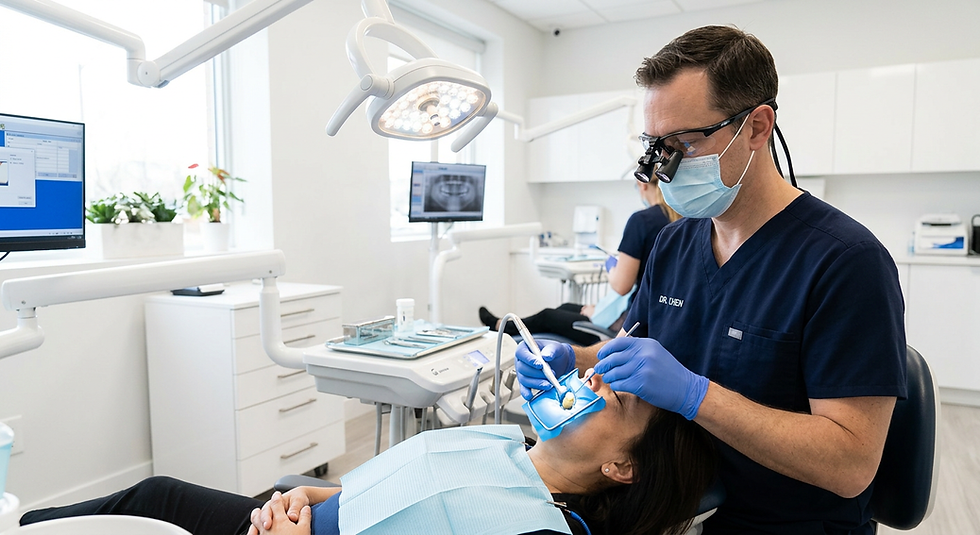
What Happens During Your Root Canal Appointment: Hour by Hour
This is the section patients find most useful a plain-language, moment-by-moment account of what the appointment actually involves.
Before the appointment (home): Take ibuprofen 400 mg approximately one hour before your appointment if you are not contraindicated this pre-emptive anti-inflammatory significantly reduces post-operative discomfort. Eat a normal meal beforehand. Do not arrive on an empty stomach if you are receiving nitrous oxide sedation.
Arrival and preparation (minutes 0–15): You check in, are seated in the dental chair, and the treatment tooth is confirmed. Any pre-operative X-rays are reviewed. The dental dam a thin rubber sheet with a small hole for the tooth is placed and secured with a clamp around the tooth. The dam isolates the tooth completely from saliva and keeps the treatment field sterile.
Anaesthesia (minutes 15–25): Topical numbing gel is applied to the gum tissue, then local anaesthetic is administered. For lower molars which are the most commonly challenging to numb additional techniques (intraligamentary injection, supplemental buccal infiltration) may be used. Dr. Reza tests the tooth for complete numbness before any instrumentation begins. If you feel anything sharp at any point, raise your hand immediately more anaesthetic will be administered before continuing.
Access opening (minutes 25–35): A small opening is made through the top of the tooth (or through existing filling or crown material) to access the pulp chamber. For an already decayed or broken tooth, this step is quick. The infected or inflamed pulp tissue is gently removed from the pulp chamber.
Canal shaping and cleaning (minutes 35–75): This is the primary phase of the procedure. Using a series of progressively larger nickel-titanium rotary instruments, Dr. Reza shapes each canal to a consistent taper creating the space for thorough cleaning and final sealing. Between instruments, the canals are irrigated with sodium hypochlorite solution (a disinfectant) to flush out debris and kill bacteria deep in the canal system. This step takes the most time a molar with three or four canals takes longer than a front tooth with one.
You feel pressure and vibration during this phase. No sharp pain if the anaesthesia is working properly.
Canal obturation filling the canals (minutes 75–90): Once the canals are confirmed clean, shaped, and dried, they are filled with a biocompatible material called gutta-percha a rubber-like compound that fills the canal space completely and seals it against bacterial re-entry. A sealing cement is used alongside the gutta-percha. A post-operative X-ray confirms the canals are fully sealed to the apex (tip) of each root.
Temporary restoration (minutes 90–100): The access opening is sealed with a temporary filling material. In some cases, if sufficient tooth structure remains and a crown is not immediately planned, a more permanent filling may be placed the same day. Most root canal-treated back teeth, however, receive a temporary seal and return for crown placement within a few weeks.
Leaving the appointment: The anaesthetic takes 2–4 hours to fully wear off. Eat soft foods until the numbness resolves to avoid inadvertently biting your cheek or tongue. Once the anaesthetic wears off, some tenderness around the tooth and jaw muscle soreness (from holding your mouth open) is normal. Take ibuprofen as needed it is the most effective OTC option for post-endodontic discomfort.
Recovery: What to Expect in the Days After
Day 1: Mild to moderate soreness when biting on the treated tooth is normal and expected. The tooth has been instrumented and the surrounding bone and ligament have an inflammatory response. Ibuprofen 400 mg every 6–8 hours manages this effectively for most patients.
Days 2–3: Soreness typically peaks around day 2 then begins to improve. Some patients experience a slight swelling of the surrounding gum tissue normal unless accompanied by spreading facial swelling, fever, or worsening rather than improving pain.
Days 3–7: Significant improvement for most patients. Biting on the tooth becomes more comfortable. The temporary filling should feel stable.
When to call us immediately:
Spreading facial swelling or difficulty opening your mouth (beyond mild jaw muscle soreness)
Fever above 38°C
Worsening pain after day 3 rather than improvement
The temporary filling feels very high on your bite and does not settle after 48 hours
The temporary filling comes out entirely
📞 Hwy7 Family Dentistry: (905) 604-1995
What Comes After the Root Canal: The Crown Timeline
For root canal-treated molars and premolars, a crown is the standard next step and it is important. Here is why and when:
Why a crown is essential after most root canals: A root canal removes the tooth's blood supply permanently. The dentinal tubules that were hydrated by the pulp gradually lose moisture over time the tooth becomes more brittle. A root canal-treated molar without a crown is at risk of fracturing under the forces of everyday chewing sometimes catastrophically, in a way that cannot be repaired.
The general guideline: any root canal-treated tooth that will take significant biting force (premolars and molars) requires a crown. Front teeth that have minimal biting load and sufficient remaining structure may be restored with a post and composite filling rather than a crown, though crowns remain the more protective option.
The timeline: At Hwy7 Family Dentistry, we typically schedule the crown appointment 2–4 weeks after the root canal is completed. This allows sufficient time to confirm the tooth is settling well before the permanent crown is placed. During this period, avoid chewing hard or sticky foods on the treated side the temporary filling is a placeholder, not a permanent restoration.
For the full crown procedure guide including types, costs, and what to expect at both appointments, see our dental crowns in Markham guide.
Root Canal Retreatment: When a Root Canal Needs to Be Redone
A root canal-treated tooth can occasionally become re-infected years after the original treatment. This typically happens when: a canal was not identified or adequately cleaned during the original procedure; the crown or coronal seal fails, allowing bacteria back into the canal space; or a new crack develops in the tooth that provides a pathway for re-infection.
Root canal retreatment involves reopening the tooth, removing the existing gutta-percha filling, re-cleaning the canal system, and resealing. Retreatment is more technically demanding than the original procedure and is often best performed by an endodontist. Root Canal Retreatment in Ontario costs $901 – $1,629 according to the ODA fee guide. archerdental
If a retreated tooth still fails to resolve the infection, an apicoectomy a minor surgical procedure to remove the tip of the root and seal it from the outside may be indicated.
Frequently Asked Questions
How much does a root canal cost in Markham?
A root canal in Markham and across Ontario typically costs 700–900 for a front tooth, 900–1,100 for a premolar, and 1,100–1,600 for a molar in 2026. An endodontist charges 20–40% more than a general dentist for the same procedure. The crown that typically follows a molar root canal adds 1,000–2,000, bringing the combined total to 1,900–4,100. Most dental insurance plans cover root canals at 50–80% of the ODA fee guide rate.
Is a root canal better than extraction?
In most cases, yes if the tooth can be properly restored with a crown afterward. A root canal preserves your natural tooth, prevents jawbone loss at the extraction site, maintains proper bite alignment, and typically costs less over 10–20 years than extraction followed by implant or bridge replacement. The exception is when the tooth is not restorable when it is cracked below the bone, has insufficient remaining structure for a crown, or has advanced bone loss from gum disease. In these situations, extraction is the appropriate choice.
Is root canal treatment painful?
No not during the procedure. Root canal treatment is performed under local anaesthetic that completely numbs the tooth and surrounding tissue. You feel pressure and vibration but no sharp pain. Post-operative soreness after the anaesthetic wears off is normal for 2–4 days and is well-managed with ibuprofen. The reputation for pain comes from the pre-anaesthetic era of dentistry and from the infection pain that brings patients to the appointment not from the treatment itself.
How long does a root canal take in Markham?
A front tooth root canal takes approximately 60–75 minutes. A molar root canal with three or four canals takes 90–120 minutes. Some complex cases may be completed across two appointments. Retreatment cases typically require more time than original treatment.
Does Hwy7 Family Dentistry do root canals?
Yes Dr. Reza performs root canal treatment on appropriate cases at our Unionville, Markham location. Cases with unusual anatomy, very fine calcified canals, or retreatment situations are referred to trusted Markham endodontists with clear coordination and communication throughout.
Does the CDCP cover root canal treatment?
Yes the CDCP covers endodontic treatment for eligible patients. Coverage percentage depends on household income tier: 100% for under $70,000, 60% for 70,000–79,999, 40% for 80,000–89,999. Important note: CDCP reimbursement is based on the CDCP grid fee (1,194foramolar),nottheODArate(1,417–$1,579). If the practice charges above the CDCP grid rate, a balance-billing gap may exist even at 100% coverage. Our team will clarify your specific out-of-pocket cost before treatment begins.
Book Your Root Canal Assessment in Markham
If you have been told you need a root canal or if you have tooth pain, sensitivity to temperature that lingers, or a tooth that has been treated before and is acting up the right step is a proper assessment with honest guidance on your options.
At Hwy7 Family Dentistry, located at 4560 Highway 7 East, Unit 500, Unionville, Markham, Dr. Reza provides thorough endodontic assessments including current X-rays, a clear clinical explanation of findings, and a written cost estimate before any treatment is scheduled. We are currently accepting new patients and hold same-day emergency slots for acute dental pain.
📞 Call us at (905) 604-1995 🌐 Book your appointment at hwy7familydentistry.ca


Comments