Invisalign in Markham: Cost, Timeline, Candidacy and What to Expect in 2026
Invisalign has changed more in the last five years than in the decade before it. The aligners are thinner, the tooth-coloured attachments smaller, and the ClinCheck digital simulation more accurate than most patients realize. For Markham residents who looked into Invisalign years ago and decided against it whether because of the price, concerns about effectiveness, or uncertainty about the process 2026 is a genuinely good time to revisit that decision.
This guide covers everything a Markham patient needs to know before booking a consultation: how much Invisalign actually costs in Ontario right now, what the treatment process looks like from first scan to final retainer, which dental concerns Invisalign can and cannot correct, and what to expect at every stage of care at an experienced Markham family dental practice.
How much does Invisalign cost in Markham in 2026?
Invisalign in Markham costs between $3,500 and $8,500 CAD depending on treatment tier and case complexity. Most patients with moderate alignment issues pay between $4,500 and $6,500. Complex cases requiring full correction of spacing, crowding, and bite issues fall at the higher end of that range. Patients with only minor corrections a single rotated tooth or a small gap may qualify for Invisalign Lite starting around $3,500.
These figures reflect 2026 Ontario market pricing. Toronto proper tends to run higher (6,000–9,000) due to overhead costs. Markham practices, including family dentists in the Hwy 7 corridor, typically price at the Ontario average rather than the downtown Toronto premium.
Invisalign pricing tiers in Ontario 2026:
Tier | Corrections Addressed | Typical Cost (Ontario) | Aligner Sets |
Invisalign Lite | Minor spacing, mild crowding, slight rotation | 3,500–5,500 | Up to 14 |
Invisalign Moderate | Moderate crowding, spacing, and mild bite correction | 4,500–6,500 | Up to 26 |
Invisalign Comprehensive (Full) | Complex cases significant crowding, spacing, open bite, overbite, crossbite | 5,500–8,500 | Unlimited (includes refinements) |
Invisalign Teen | Same correction capability as Comprehensive; includes 6 replacement aligners and compliance indicators | 4,500–7,500 | Unlimited + 6 replacements |
The tier your case falls into is determined during the clinical examination and digital scan not by what you hope for. A dentist who quotes you Lite pricing for a case that needs Comprehensive is setting you up for a poor outcome and a more expensive correction later.
What the price includes: At most Markham practices, Invisalign pricing covers the full set of custom aligners, all scheduled check-in appointments during active treatment, the digital ClinCheck treatment plan, tooth-coloured attachments (if required), and one set of retainers at completion. Refinements additional aligner sets to fine-tune the final result are included with Comprehensive and Teen tiers. They are typically charged separately for Lite.
What the price does not include: Initial consultation fee (usually 100–250; some practices waive this if treatment proceeds), replacement aligners lost beyond the included set, and whitening or other cosmetic add-ons.
Does insurance cover Invisalign in Markham?
Many private dental insurance plans with orthodontic benefits will offset part of the cost. The typical structure is a lifetime orthodontic maximum of 1,500–3,000, applied at 50% of eligible treatment costs. This means a patient with $2,000 lifetime orthodontic coverage could reduce their out-of-pocket cost by $2,000 but only if their plan covers clear aligners (most modern plans do; some older plans specify "braces" only, so check the exact language).
The Canadian Dental Care Plan (CDCP) does not currently cover orthodontic treatment, including Invisalign, except in documented cases of severe functional impairment requiring pre-authorization. For most patients, Invisalign is a private-pay or insurance-offset expense.
Payment options available at most Markham practices:
In-house monthly plans, often interest-free, typically 150–350/month
Health Spending Accounts (HSA) Invisalign is an eligible medical expense under CRA rules, so HSA dollars are tax-sheltered
Third-party dental financing (Dentalcard, iFinance Canada) for larger amounts
If cost is the primary concern, discuss the payment structure at your consultation before the clinical assessment most practices are transparent about this and will work with your budget.
Who provides Invisalign in Markham?
General dentists certified by Align Technology (the company that makes Invisalign) and orthodontists both provide Invisalign in Markham. A common question is whether a general family dentist or a specialist orthodontist delivers better outcomes. The honest answer is: provider experience and certification level matter more than specialty designation.
Align Technology ranks its certified providers by volume and training level. Titles include Preferred Provider, Premier Provider, and Platinum Provider each reflecting the number of cases a clinician completes per year and the additional training undertaken. A general dentist with Platinum Provider status has treated significantly more Invisalign patients than a specialist who recently added the service.
What to ask any Markham Invisalign provider before booking:
What is your provider certification level with Align Technology?
How many Invisalign cases do you complete per year?
Is ClinCheck included in the quoted price?
Does the price include refinements if the final result needs adjustment?
What is your protocol if I lose an aligner?
At Hwy7 Family Dentistry, Dr. Fazal provides Invisalign consultations as part of a comprehensive approach to cosmetic and orthodontic care in Markham. Extended Thursday hours to 9 PM and Saturday availability until 4 PM mean consultation and check-in appointments fit around work and school schedules. Learn more about our team and approach.
Are you a good candidate for Invisalign?
Invisalign works for a wider range of cases than most patients assume, but it does have genuine limitations. Understanding both will save you from an underpowered treatment plan.
Invisalign works well for:
Mild to moderate crowding (teeth overlapping but not severely rotated)
Gaps and spacing between teeth
Mild overbite (upper teeth extend too far over lower)
Mild underbite (lower teeth sit in front of upper)
Open bite (front teeth don't meet when back teeth are closed)
Crossbite (some upper teeth sit inside lower teeth)
Cases where previous orthodontic treatment has relapsed slightly
Invisalign has real limitations for:
Severely rotated teeth (especially round-root canine teeth) aligners cannot generate the same rotational force as fixed braces on all tooth shapes
Large vertical movements (significant intrusion or extrusion of individual teeth)
Skeletal jaw discrepancies that require surgical correction
Patients with active gum disease periodontal health must be stabilized before orthodontic treatment begins
Very young children whose teeth are still erupting Invisalign First exists for some early interceptive treatment, but is not appropriate for all paediatric cases
The most reliable way to know whether your case is a good fit is the ClinCheck digital simulation described below. If the ClinCheck cannot model a satisfactory final result with aligners, an experienced provider will tell you so and discuss alternatives.
Compliance is also candidacy. Invisalign requires 20–22 hours of aligner wear per day. Patients who remove their aligners frequently for meals, sports, or social occasions will not achieve the planned result on schedule. Invisalign Teen includes compliance indicators small blue dots on the aligner that fade with wear specifically because teen compliance is variable. Adults who know they will struggle with wear time should discuss this honestly at the consultation rather than after treatment stalls.
The Invisalign process at a Markham family dental practice: step by step
Step 1 The consultation (30–60 minutes)
The first appointment is a clinical examination and conversation. The dentist reviews your bite, photographs your teeth, and discusses your goals. This is also when you confirm the provider's certification level, discuss pricing tiers, and ask questions before any commitment is made. Bring your insurance information the front desk can verify orthodontic benefits on your behalf.
Step 2 Digital scan and ClinCheck treatment plan (1–2 weeks after consultation)
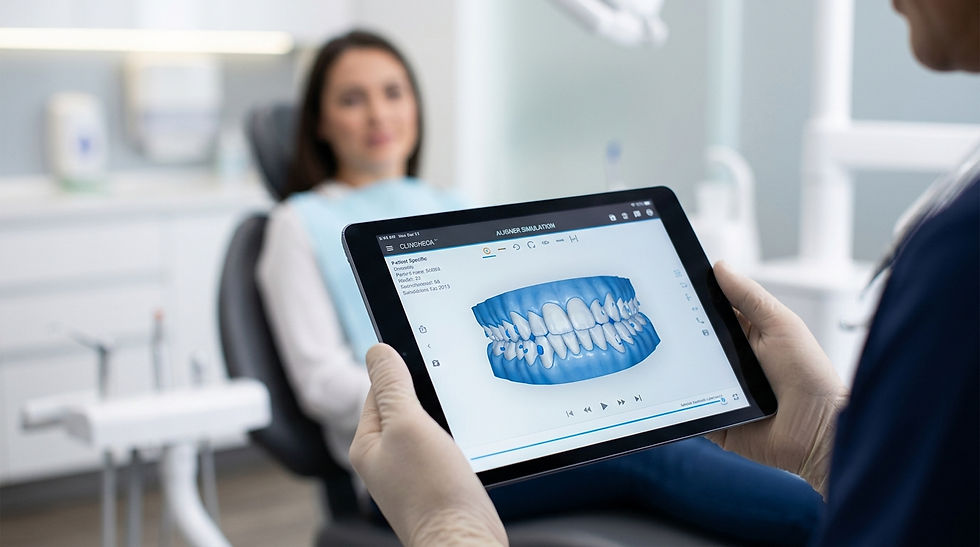
If you proceed, the practice takes a digital 3D scan of your teeth using an intraoral scanner no impressions, no tray, no mess. The scan generates the ClinCheck: a digital simulation that shows your teeth moving from their current position to the planned final result, one aligner stage at a time.
You review the ClinCheck with your dentist before any aligners are fabricated. This is your opportunity to see the predicted outcome, raise questions about specific teeth, and request adjustments to the plan. ClinCheck is not a guarantee of outcome tooth movement has biological variability but it is the most accurate preview available in orthodontics today.
Step 3 Aligner fabrication (2–4 weeks)
Once the ClinCheck is approved, Align Technology fabricates your custom aligner sets at their manufacturing facility and ships them to the practice. The full set for your case arrives at once; you receive them in numbered batches.
Step 4 Fitting appointment and attachments (45–60 minutes)
At the fitting appointment, the dentist bonds any necessary tooth-coloured attachments to specific teeth. Attachments are small dots or ridges of composite resin that give the aligners leverage to move teeth in directions the aligner surface alone cannot achieve they are the main reason Invisalign can now handle cases that were beyond its capability a decade ago. Most patients find them nearly invisible in daily life.
Your first and second aligner sets are fitted and checked for proper seating. The dentist demonstrates insertion and removal technique there is a specific method that protects both the attachments and the aligner material and reviews your wear and care instructions.
Step 5 Active treatment (6–24 months depending on tier and case)
You wear each set of aligners for 1–2 weeks (your dentist specifies the exact interval based on your case) before moving to the next set. Check-in appointments are every 6–10 weeks. These appointments are brief typically 20–30 minutes and exist to verify tooth movement is on track, make any necessary aligner adjustments, and supply the next batch of trays.
Realistic timelines by tier:
Invisalign Lite: 3–6 months
Invisalign Moderate: 6–12 months
Invisalign Comprehensive: 12–24 months
Invisalign Teen: 12–18 months (varies by compliance)
Step 6 Refinements (Comprehensive and Teen tiers)
At the end of the planned aligner series, most patients need refinements a second (sometimes third) round of aligners to achieve the final few degrees of tooth movement that the first series did not fully complete. This is normal and expected, not a sign of failure. Refinements require a new scan, a new ClinCheck, and a new aligner fabrication cycle of 2–4 weeks.
Refinements are included in Comprehensive and Teen tier pricing. If you are quoted Lite pricing for a case that turns out to need refinements, those are typically a separate charge which is why accurate tier selection at the consultation stage matters.
Step 7 Retainers (permanent requirement)
When active treatment ends, you receive retainers. The most common type is a clear Essix retainer essentially the same material as your aligners worn full-time for the first 3–6 months, then nightly indefinitely.
This is the part most patients underestimate: teeth move throughout life, and retainers are the only thing preventing relapse. Patients who wore braces as teenagers and saw their results shift know this firsthand. Without nightly retainer wear, the changes Invisalign produced will partially reverse over months to years. This is not a failure of Invisalign it is the biology of teeth and bone.

Invisalign vs. braces in Markham: the honest comparison
For a full comparison of Invisalign versus traditional metal braces in the Markham context, including treatment timeline, cost differences, and which conditions each handles better, see our dedicated guide: Braces vs. Invisalign in Markham: Which Is Right for You?
The short version: Invisalign is more convenient and aesthetically superior for most adult and teen cases. Braces remain more effective for severely rotated teeth, large vertical movements, and cases where patient compliance is genuinely uncertain. For most Markham adults with mild to moderate alignment concerns, Invisalign is the appropriate choice and the 2026 product generation handles a wider range of cases than its predecessors.
For information on how long your total orthodontic treatment timeline will be, see: How Long Do Orthodontic Treatments Take? A Markham Patient Guide
Invisalign and cosmetic dentistry: what order to do things in
Patients who want both Invisalign and other cosmetic treatments teeth whitening, bonding, or veneers should plan the sequence carefully.
Always complete Invisalign before:
Teeth whitening: Whiten after alignment is complete so you whiten your final smile, not a smile that is about to change shape. Whitening also refreshes the result effectively once alignment is complete.
Dental bonding: Bonding composite resin does not move with your teeth. If bonding is placed before Invisalign, the aligner may not seat properly over the bonded surface, or the bonded tooth may not move as planned. Complete Invisalign first, then bond. (See our guide: Dental Bonding in Markham: The Affordable Cosmetic Fix Most Patients Overlook)
Porcelain veneers: Veneers are a permanent alteration of tooth structure. Planning veneer placement on teeth that have not yet reached their final aligned position is poor sequencing. Align first, then assess whether veneers are still needed or desired.
Exception: Dental crowns, implant crowns, or large existing restorations present before Invisalign can complicate tooth movement discuss any existing restorations with your Invisalign provider during the consultation so the ClinCheck accounts for them.
For a broader overview of cosmetic treatment options and how they work together, see: Complete Guide to Cosmetic Dentistry in Markham: Treatments, Costs & Results
Caring for your aligners: the practical rules:
Rinse aligners every time you remove them saliva dries and creates a film that causes odour and discolouration.
Clean with a soft toothbrush and mild soap or the Invisalign cleaning crystals never hot water (it warps the aligner) and never toothpaste (it scratches the surface and makes aligners visibly cloudy).
Brush and floss before reinserting after eating trapping food particles under aligners for hours creates the conditions for rapid decay, which is the primary clinical risk of Invisalign that patients underestimate.
Store aligners in their case when not in your mouth not in a napkin, not loose in a pocket or bag. Lost aligners are the most common cause of treatment delays.
Avoid drinks other than water while wearing aligners coffee, tea, juice, and anything with sugar or acid sits against your tooth enamel for extended periods under the aligner. Sparkling water is fine; everything else comes out first.
Frequently asked questions about Invisalign in Markham
How much does Invisalign cost in Markham in 2026?
Invisalign in Markham costs 3,500–8,500 CAD depending on the treatment tier. Invisalign Lite for minor corrections starts around 3,500–5,500. Comprehensive full-treatment cases range from 5,500–8,500. Most patients with moderate alignment issues pay between $4,500 and $6,500. Toronto practices typically charge 6,000–9,000 for equivalent cases; Markham pricing reflects Ontario averages rather than downtown Toronto overhead.
Does Invisalign hurt?
Invisalign causes pressure and mild discomfort when a new set of aligners is placed typically in the first 24–48 hours after switching. This is the aligner actively moving your teeth and is an expected sign that treatment is working. OTC ibuprofen or acetaminophen manages this effectively. Most patients describe the discomfort as notably less than the soreness following traditional braces adjustments.
Can I eat whatever I want with Invisalign?
Yes because you remove the aligners to eat, there are no dietary restrictions. This is one of the most practical advantages over braces. The trade-off is discipline: you must brush before reinserting, and you must wear aligners for 20–22 hours per day even when eating frequently requires removing them.
What if I lose an aligner?
Contact your practice immediately. In most cases, your dentist will advise you to go back to the previous set temporarily while a replacement is ordered. Invisalign Teen includes six replacement aligners at no additional charge. Comprehensive and Lite replacements are typically charged at cost around 100–200 per aligner. This is another reason the case is kept in its case at all times.
Can Invisalign fix my bite, not just straighten my teeth?
Mild to moderate overbites, underbites, open bites, and crossbites are within Invisalign's current correction range. Severe skeletal discrepancies where the jaws themselves are misaligned rather than just the teeth require orthodontic treatment combined with surgery or other interventions that Invisalign cannot replicate. Your consultation and ClinCheck will make this clear.
How is Invisalign different from cheaper online clear aligner brands?
Direct-to-consumer brands (SmileDirectClub, Byte, Candid) market clear aligners at lower prices without in-person clinical oversight. The significant risks: bite changes are not monitored by a licensed dentist throughout treatment; complex movements beyond their approved scope can be attempted without clinical judgment; and there is no one to identify gum or bone health changes during treatment. The Ontario Dental Association and the RCDSO advise against unsupervised clear aligner treatment for these reasons. Invisalign is an in-person, dentist-supervised treatment that supervision is a core part of what makes it safe and predictable.
Ready to start your Invisalign journey in Markham?
If you are a Markham dentist patient looking for a family dental practice that offers Invisalign consultations with flexible appointment times, Hwy7 Family Dentistry at 4560 Hwy 7 East, Unit 500, Unionville, is accepting new patients.
Extended hours including Thursday evenings to 9 PM and Saturdays 9 AM to 4 PM mean your consultation and check-in appointments work around your schedule, not the other way around. View all our dental services or contact us to book your Invisalign consultation.


Comments